Showing posts with label rationality. Show all posts

Thursday, May 13, 2021

For the Annals of Lateral Thinking: Ohio makes vaccinating into a million-dollar lottery.

Governor Mike DeWine announces on Twitter: 

Two weeks from tonight on May 26th, we will announce a winner of a separate drawing for adults who have received at least their first dose of the vaccine. This announcement will occur each Wednesday for five weeks, and the winner each Wednesday will receive one million dollars.

The pool of names for the drawing will be derived from the Ohio Secretary of State’s publicly available voter registration database. Further, we will make available a webpage for people to sign up for the drawings if they are not in a database we are using. The Ohio Department of Health will be the sponsoring agency for the drawings, and the Ohio Lottery will conduct them. The money will come from existing federal Coronavirus Relief Funds.

To be eligible to win, you must be at least 18 years of age or older on the day of the drawing. You must be an Ohio resident. And, you must be vaccinated before the drawing. We will have further, specific details tomorrow and in the days ahead.

I know that some may say, “DeWine, you’re crazy! This million-dollar drawing idea of yours is a waste of money.” But truly, the real waste at this point in the pandemic -- when the vaccine is readily available to anyone who wants it -- is a life lost to COVID-19.

You could spend $5 million on ads cajoling people — or shaming them — into getting vaccinated. One way or another, it costs money to complete the vaccination project. The great thing about the lottery idea is that it's an effort to reach minds that are not primarily oriented to science — people who are emotional and transrational.

Am I making up the word "transrational"? I had to look it up. I can't credit myself with coinage. There's a whole Wikipedia article, but let's see if it means what I — in my thwarted word-coining effort — had in mind:

Transrational... refers to the experience of phenomena occurring within the natural universe where information and experiences does not readily fit into the typical cause and effect structure; the kinds of experience that are often dismissed as unfathomable or superstitious. It differs from the ‘supernatural’ and the ‘rational’ in that it neither directly controverts nor affirms rational reason. A transrational experience is not pathological. One of the most popular examples of transrational experiences are individuals witnessing blessed/evil omens which turn out to become true, or feelings of extremely intense dread which helped staved an individual from disastrous catastrophes, even if the individual has zilch prior knowledge or context....

People are often so afraid of being considered "pre-rational" that they avoid and deny the possibility of the transrational....

Well, this particular Wikipedia article isn't written according to the usual Wikipedia standards. It's more like a blog post. There's an effort to flip rationality into irrationality: People cling to rationality out of fear. That's not an entirely irrational thing to say, but it's just interesting speculation. I happen to think many people irrationally believe in their own rationality, but the answer to that isn't to become "transrational," but to work endlessly on the rationality of your rationality, which is not easy.

The Wikipedia article ends with 6 examples of the transrational, beginning with this:

[After an account of human communication with animals and stones] “Of course, many of us shudder when we think of some of our companions who do talk with inanimate objects or invisible friends. Yet even here, I think that psychologists’ scholarly prejudices have often overcome their common sense and analytical skills. The point is not whether people talk to animals and plants, but the validity of the messages that are given and received.”

In that light, may I recommend the Haruki Murakami story "Confessions of a Shinagawa Monkey"? It's in this new collection. A man encounters a monkey who talks to him at some length — about how he learned to speak, about how his only sexual attraction is to human females, and about how he fulfills his sexual needs by "stealing" part of the name of each woman he loves. But can the man tell anyone about the talking monkey?

Why try if no one would ever believe me? People would only end up saying I was just “making up stuff again.” I also couldn’t figure out what format to use. It was way too bizarre to write about it as if it were real, and as long as I couldn’t provide proof—proof, that is, that the monkey actually existed—no one would ever buy it. That said, if I wrote about it as fiction, it lacked a clear focus, or a point. I could well imagine, even before I started writing about it, my editor’s puzzled expression after reading the manuscript, and the question that would follow: “I hesitate to ask you, since you’re the author, but—what’s the theme of this story supposed to be?” Theme? Can’t say there is one. It’s just about an old monkey who speaks human language, in a tiny town in Gunma Prefecture, who scrubs guests’ backs in the hot springs, enjoys cold beer, falls in love with human women, and steals their names. Where’s the theme in that? Or moral?

That's not how the story ends. There's more, and it's quite satisfying.

Monday, May 10, 2021

"But she wasn’t interested in a rational discussion. She interrupted me mid-sentence, launching into a monologue about John Bolton..."

"... the former Ambassador to the United Nations and a fellow at AEI (and subsequently National Security Advisor to President Trump). Bolton, my friend insisted, was a loathsome, hateful, racist, neo-conservative warmonger. The list went on and on until eventually she said that he looked like a walrus with a moustache. You could tell by his physiognomy, she explained, that he was a psychopath. 'But what about the policies?' I responded, trying to redirect the conversation away from personalities. The more she spoke, the more I recognised her broad disposition as something I had experienced earlier in my life. Her attitude was almost entirely tribal. Two things, in particular, stood out: an almost blind hatred of a particular group (Republicans); and secondly, the use of deeply personal attacks on individual researchers to justify that hatred."

From "Tribalism has come to the West/Hostile and polarised, today's America reminds me of my Somalian clan" by Ayaan Hirsi Ali (who worked at AEI at the time of that conversation).

The puzzling intensity of bile.

Let's take a closer look at that bile. Is there bile at all?
I would like to thank this headline/byline combo for helping me set a record for the quickest "gross, pass" I've ever uttered in my life.

Bile is anger. "Gross, pass" is disgust.  One might perhaps base an entire career on examining the anger/disgust distinction, but I think the key distinction is the direction of the negative emotion. Anger urges you to take aggression at the source of your outrage. Disgust sends you away. You shun. It's the difference between wanting to attack what you hate and wanting to make sure you don't get any of that on you. Marcotte experiences disgust — "gross" — and immediately shuns — "pass." Her measure of the intensity of disgust is the shortness of the space between the emotion and the reaction. She's open and proud of the absence of rational thought. It's a feeling and a decision all at once — "gross, pass."

Having decided not to expose herself to the text of the article, Marcotte is free to enjoy herself: "The funniest part" — funniest part of the headline — "is framing 25 like it's some daringly young age. The average age of first childbirth is 26." Is that really funny? I haven't read the op-ed yet myself. I saw it, did a quick skim, and decided it wasn't bloggable, but I didn't think — like Marcotte — that my rejection of it was bloggable (i.e., tweetable). I'm going to read it in a minute, but I want to say that Marcotte comes off as privileged. I'm guessing that if the average age is 26, that includes a lot of very young women who are not spending their late teens and early 20s acquiring higher education and beginning career, that is, are not the sort of women who are reading NYT op-eds about timing their reproductive life. 

The Marcotte tweet cannot be clicked to get to the op-ed, so let me give you the link: "I Became a Mother at 25, and I’m Not Sorry I Didn’t Wait" by Elizabeth Bruenig. Starting to read it, I see what made me reject it before. It's written at privileged NYT readers who care about the upper-middle class setting of child rearing. The writer finds herself, at age 27, "among a cordial flock of Tory Burch bedecked mothers in their late 30s and early 40s." Sorry, I don't know the brand, but I understand the nudge. "Tory Burch" is telling me these people are upper-middle class. The average age of pregnancy among "Tory Burch bedecked" women is not — I'm quite sure — 26.

When my husband and I compared notes after the [birthday party], he recounted a sly line of questioning spun by a curious partygoer that he thought was aimed at determining how, given our ages, we could afford the ritzy preschool that our daughter attended with theirs. 

Speaking of sly... you've let us know your kid goes to a ritzy preschool. Okay. Well, women who plan their reproduction think about the economics. There's going to need to be some info about how you can have your children young and still give them the benefits of an upper-middle class lifestyle. In Bruenig's case, this preschool was free to those living inside Washington, D.C. 

Bruenig is clearly talking about highly educated women — women who aspire to affluence:

A 2012 Pew survey found that while 62 percent of women with a high school diploma had given birth by the age of 25, only 18 percent of women with master’s degrees or higher had done the same. In fact, a solid 20 percent of master’s degree holders celebrated their first babies at 35 or older. Unsurprisingly, these numbers track with household income. As of 2018, more than half of women living on less than $25,000 per year between the ages of 40 and 45 report having given birth by the age of 25; among women banking $100,000 or more, the share was a touch over 30 percent....

Highly educated professionals living in major urban centers — in other words, people like me, a lily-white full-time writer with a master’s degree living within rail distance of New York City — tend to postpone childbirth until their late 20s and early 30s....

Yes, she called herself "lily-white." She's talking to white women. But you're not supposed to worry that she's afraid of the so-called "replacement" because she's made it clear — in material I've elided — that she loathes right-wingers.

While my husband and I were never in abject poverty, we understood what it meant to be precariously employed and at the start of our careers.... Reasonable concern about having children before establishing oneself could theoretically be remedied with a generous policy approach....

But what of having children — or getting married, for that matter — before establishing oneself?... When I got pregnant, my husband was a fledgling lawyer and I was a greenhorn journalist....

Once you're pregnant and decided to go through with it, all these economic matters will dissolve into a kaleidoscope of love:

When you have a baby, you do turn toward your child — that “relieved and joyful desertion” may eventually affect your friends, but it first affects yourself. What I didn’t understand — couldn’t have, at the time — was that deserting yourself for another person really is a relief.... My days began to unfold according to her schedule, that weird rhythm of newborns, and the worries I entertained were better than the ones that came before: more concrete, more vital, less tethered to the claustrophobic confines of my own skull.

For this member of a generation famously beset by anxiety, it was a welcome liberation....

You catch glimpses of yourself in time, when life shines through your inner world like a prism, illuminating all the sundry colors you contain. It isn’t possible to disentangle the light from the color, the discovery of change from the change itself....  But she peered up at me from the shadow of my shoulder, and I could see the umber of my own eyes taking shape in hers. There I am, I thought, there I am.

Ha ha. Too bad Marcotte didn't read through to all that. I'll bet she'd find the "sundry colors" and "umber of my own eyes" even funnier than the notion that 26 is a daringly young age to have your first baby. 

All these women who are thinking so hard about where on the timeline of life to place their unleashing of reproductive power? Don't think, let it happen, behold your miracle, and exult in your liberation from "the claustrophobic confines of my own skull." 

Ironically, that reminds me of Marcotte. As I said above: She's open and proud of the absence of rational thought.

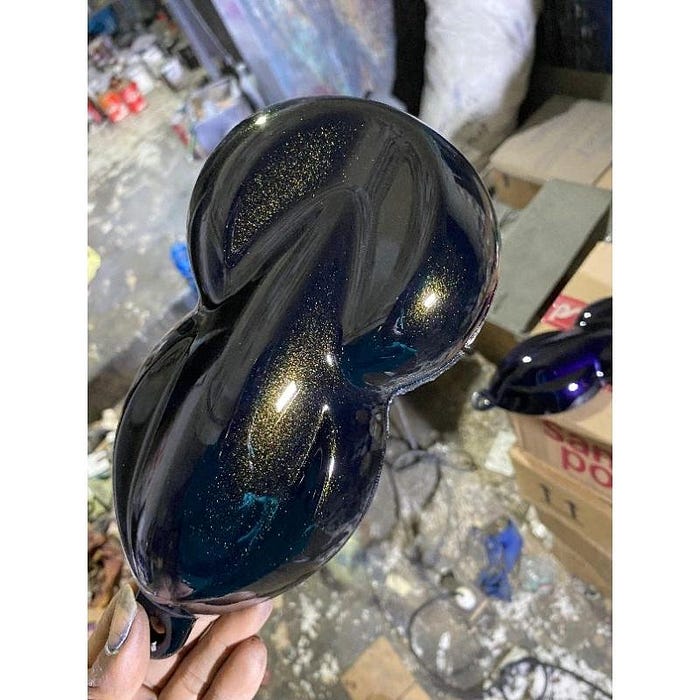
Cat Moonblack gold PU

  Cat Moonblack gold PU  adalah salah satu series yang mengandung partikel kecil seperti crystal yang dan memiliki effect lebih gelap sehing...