Showing posts with label science. Show all posts

Friday, May 14, 2021

"I’m terrified... Terrified, and I do not scare easily."

I'm reading the top-rated comment at the NYT article, "Hundreds of Epidemiologists Expected Mask-Wearing in Public for at Least a Year/The C.D.C. said Thursday that vaccinated Americans no longer needed masks in most places. Other disease experts recently had a different message: that masks were necessary in public." 

The NYT seems to be stimulating fear in reaction to the CDC announcement. The survey the headline refers to was taken before the CDC took its new position, so these epidemiologists — 723 of them — were, I suspect, passing along the party line. Did they do their own studies? Even if they did, do they study the costs of the restrictions or simply, endlessly default toward caution?

Here's the full comment: 

This is a horrible, horrifying decision. There’s no way to prove who’s vaccinated and who isn’t. People are going to lie about their status. We were out shopping today and my husband saw a woman wearing a mask that said “This mask is as useless as my Governor.” Does she seem trustworthy? Does she maybe seem like someone who’d doff her mask at the first chance, whether she’d been vaccinated or not, because she’s an imbecile and has no regard for the lives of others?

What difference does it make? If you know you're vaccinated and you believe vaccines work, you're fine without your mask, and only the unvaccinated are at risk. Why are you obsessing about the mind of a stranger?

That's a social/political relationship, and it's got nothing to do with the science of disease. Ironically, you're scoffing at her lack of adherence to science while you yourself veer away from science. I know social life and politics are more fun, but if you get your jollies from imposing physical restraints on other people, you need to look into your own heart.

The comment continues:

I think that it’s moronic to lift the ban until enough of the population has been vaccinated to achieve herd immunity. I’m including the under-18s in that. I had Covid last August and it has ripped my life apart. I’m terrified of the prospect of getting it again. Terrified, and I do not scare easily. Fewer masks and fewer precautions means more chances for the virus to mutate. We don’t know if the vaccines will protect us from mutations. I do not know what having Covid again would do to me, but I’ll tell you up front that permanent damage to my sense of smell would be ample reason for me to give serious consideration as to whether I still want to live.

Oh, &*%$ hell. I haven't had Covid, but I've lived with a seemingly permanent loss of the sense of smell for years. I don't go around saying it makes life not worth living! What crazy hysteria! And from a person who claims not to be easily scared. I guess it's all relative. Maybe this person lives in a truly timorous community. In the land of the raving hysterics, the terrified man is equanimous.

I can’t let go of the fear of what could happen to my loved ones. I’m stunned that the CDC has acted so irresponsibly.

Why not just say you're stunned to hear the new announcement? What is the basis for judging it to be irresponsible? You seem to be substituting your emotion for science. I know, though. This commenter can say he's relying on the NYT survey of 723 epidemiologists. I wonder if there's a term for the pseudoscience of surveying large groups of experts. 

Thursday, March 4, 2021

"The doctors-facts-science mantras have become familiar over the past year. The experts tell us, expertly, what we need to know, and we do it."

"At least until all this science starts to fog up our mental windshields and we, the people, start to wear out. Our irritability mounts; our attention wanes; the guide-rope in our mouth starts to chafe. It is then that the bawdy obstreperousness and its odd twin, the glory hallelujah, of democracy come into view — a single unit; maddening, infuriating, nevertheless fused. And Greg Abbott or someone else steps up to lead the beast forward, by instinct if not by Hoyle... The love of democratic citizens for experts shouldn’t be overestimated. The nature of democracy is preference for or deference to popular wisdom, however unwise that wisdom may prove in action. It’s been a long time since this pandemic started. People are tired. People want to see, and relate to, each other. That’s human nature. The human nature-affirmers like Greg Abbott, with a little luck and sense of timing, are likely to come out way ahead of their castigators and vilifiers, Robert Francis (Beto) O’Rourke conspicuously included."

Writes William Murchison in "Glory Hallelujah for Texas!/Gov. Greg Abbott takes a calculated gamble on we, the people against the experts" (The Spectator).

The Spectator is British, but Murchison is American. He even went to the University of Texas. I had to look that up because the use of "glory hallelujah" hit my ear as a foreigner's mistake. To me, the phrase — which you see in the title and the text ("its odd twin, the glory hallelujah, of democracy") — is entirely evocative of "The Battle Hymn of the Republic," and Texas was in the Confederacy. 

Puzzling, I ran across this 2018 NPR article, "How 'The Battle Hymn of the Republic' became an anthem for every cause": 

There's an episode of The Johnny Cash Show from 1969 where the man himself makes a little speech with a pretty big error. "Here's a song that was reportedly sung by both sides in the Civil War," Cash says, guitar in hand, to kick off a performance of "The Battle Hymn of the Republic.... which proves to me that a song can belong to all of us."


Cash was wrong, but in the years after the Civil War, the song came to be sung in church, at football games, and at labor union events. And on all sorts of political occasions:

Anita Bryant, the singer and conservative activist, used to perform the song at anti-gay rallies. During the 1964 presidential race, Republican nominee Barry Goldwater had to disown a campaign film that posed the election as a choice between two Americas — an "ideal" America, where the tune of the "Battle Hymn" scored images of the founders and the Constitution, and a "nightmare" America, featuring black people protesting and kids dancing to rock music.

On the flipside, the day before he was killed in 1968, Martin Luther King Jr. made his famous "I've Been to the Mountaintop" speech, which he ended by quoting the song's first line: "Mine eyes have seen the glory of the coming of the Lord." His home church, Atlanta's Ebenezer Baptist, took up the song after his death as an anthem to him and the civil rights movement.

"How people relate to patriotism is kind of how they come into the 'Battle Hymn,' " says professor Brigitta Johnson, an ethnomusicologist at the University of South Carolina who teaches in the schools of Music and African-American Studies. "For example, your white nationalists digging deep into heavy patriotism messages — they bring up things like 'The Star-Spangled Banner' and the 'Battle Hymn' and it becomes their battle cry, just as easily as it could become the battle cry for Ebenezer in Atlanta."...

"The kumbaya moment will not be happening across the aisles because of this song," [Johnson] says, "because it's really about supporting whatever your perspective is — about freedom or liberation, and having God as the person who's ordaining what we're doing. And 'glory, hallelujah' about that."

As Johnny Cash said in 1969, "The Battle Hymn of the Republic" is an anthem that belongs to everybody. But what really matters is what they're singing it for.

That meshes well with Murchison's point about human nature and human nature-affirmers.

Tuesday, May 5, 2020

"Tengujo can be made so thin that, at a certain point, it is too insubstantial for even the most gentle, decorative uses."

"At the width of a couple of kozo fibers, the paper becomes as thin as the wings of a mayfly. Only one use remains then: paper conservation. Trying to aggressively mend a document is risky because long-term chemical and physical effects are highly variable and relatively unknown. 'The more and more I am in this field, I feel that I should do less and less,' Ms. Choi said. So, as far as reinforcement material goes, the thinner the better.... The width of this thinnest tengujo is the same as the diameter of a single kozo fiber: 0.02 millimeters.... Slicing a 3-millimeter strip of Hidaka Washi tengujo with an ethanol-activated adhesive brushed onto one side, Ms. Choi gently covered an imperfection in Pinckney’s yellowing page. With a little push, the papers melted into each other. From a normal reading distance it looked as if nothing had been done, but under close examination you could see tiny strands of kozo gripping onto the ink....."

From "The Thinnest Paper in the World" (NYT).

Kozo is material — stems — from mulberry trees.

Choi is Soyeon Choi, "the head paper conservator at the Yale Center for British Art."

Pinckney is Eliza Pinckney, who was "a prominent American agriculturalist" and who wrote that letter in 1753.


From her Wikipedia article:
Eliza was 16 years old when she became responsible for managing Wappoo Plantation and its twenty slaves, plus supervising overseers at two other Lucas plantations, one inland producing tar and timber, and a 3,000 acres (12 km2) rice plantation on the Waccamaw River. In addition she supervised care for her extremely young sister, as their two brothers were still in school in London. As was customary, she recorded her decisions and experiments by copying letters in a letter book. This letter book is one of the most impressive collections of personal writings of an 18th-century American woman. It gives insight into her mind and into the society of the time.

From Antigua, [her father] Col. Lucas sent Eliza various types of seeds for trial on the plantations. They and other planters were eager to find crops for the uplands that could supplement their cultivation of rice. First, she experimented with ginger, cotton, alfalfa and hemp. Starting in 1739, she began experimenting with cultivating and improving strains of the indigo plant, for which the expanding textile market created demand for its dye. When Col. Lucas sent Eliza indigofera seeds in 1740, she expressed her "greater hopes" for them, as she intended to plant them earlier in the season. In experimenting with growing indigo in new climate and soil, Lucas also made use of knowledge and skills of enslaved Africans who had grown indigo in the West Indies and West Africa.

After three years of persistence and many failed attempts, Eliza proved that indigo could be successfully grown and processed in South Carolina. While she had first worked with an indigo processing expert from Montserrat, she was most successful in processing dye with the expertise of an indigo-maker of African descent whom her father hired from the French West Indies.

Eliza used her 1744 crop to make seed and shared it with other planters, leading to an expansion in indigo production. She proved that colonial planters could make a profit in an extremely competitive market. Due to her successes, the volume of indigo dye exported increased dramatically from 5,000 pounds in 1745–46, to 130,000 pounds by 1748.[4] Indigo became second only to rice as the South Carolina colony's commodity cash crop, and contributed greatly to the wealth of its planters. Before the Revolutionary War, indigo accounted for more than one-third of the total value of exports from the colony....

This letter book is one of the most complete collections of writing from 18th century America and provides a valuable glimpse into the life of an elite colonial woman living during this time period. Her writings detail goings on at the plantations, her pastimes, social visits, and even her experiments with indigo over several years. Many scholars consider this letter-book extremely precious because it describes everyday life over an extended period of time rather than a singular event in history....
There's a Pinckney Street in Madison, Wisconsin because of her son, Charles Cotesworth Pinckney, who was one of the founders of the United States Constitution.

You can read some excerpts from Eliza Pinckney's letter book here. Example (from May 1742):
Wont you laugh at me if I tell you I am so busey in providing for Posterity I hardly allow my self time to Eat or sleep and can but just snatch a minnet to write you and a friend or two now. I am making a large plantation of Oaks which I look upon as my own property, whether my father gives me the land or not; and therefore I design many years hence when oaks are more valueable than they are now — which you know they will be when we come to build fleets.  I intend, I say 2 thirds of the produce of my oaks for a charity (I'll let you know my scheme another time) and the other 3rd for those that shall have the trouble of putting my design in Execution. I sopose according to custom you will show this to your Uncle and Aunt. “She is [a] good girl,” says Mrs. Pinckney. “She is never Idle and always means well.” “Tell the little Visionary,” says your Uncle, “come to town and partake of some of the amusements suitable to her time of life.” Pray tell him I think these so, and what he may now think whims and projects may turn out well by and by. Out of many surely one may hitt. . .

Saturday, March 14, 2020

"That is science."

View this post on Instagram

w r o n g n e s s

A post shared by Strange Planet (@nathanwpylestrangeplanet) on

"A virus is a peculiar object that is inert and arguably not truly alive outside a host. Only when it invades a cell and hijacks its machinery can the virus begin to replicate."

"Outside, on an inanimate surface, the virus will gradually lose the ability to be an infectious agent. It may dry out, for example. It can degrade when exposed to ultraviolet radiation from the sun. A person sneezing on a surface may deposit many thousands of virus particles, and some may remain viable for days. Still, the likelihood of a person who comes into contact with the remnants of that sneeze goes down over time, because most infections are the result of a large viral load.... [T]ypically it takes 'an army of viruses going in' to break through the natural defenses of a human being, which include mucus that lines airways...."

From "Coronavirus can stay infectious for days on surfaces. But it’s still okay to check your mail" (WaPo).

How are you dealing with "fomites" (surfaces that may have the virus)? It's hard to think about everything, but we've been careful bringing mail and packages into the house. We leave the boxes and bags outside and let various objects (including the mail) sit around on a table for a day or so before we touch them again (and we wash our hands after touching them to bring them to the table). Out in the world, I don't touch anything people may have touched, or I regard my own hands/gloves as tainted until I can wash them. I use a pencil to punch the buttons on the parking meter.

But it's good to have more information about how long the virus survives on objects and how likely you are to get infected through fomites. I don't have anything like a scientific grasp on how the virus ceases "to be an infectious agent"? When and how does it "degrade"? It doesn't die, because it isn't alive. Or must I say "arguably not truly alive"? I guess scientists argue about what it means to be "truly alive." Why can't they agree?

The question of what it means to be "truly alive" sounds like something nonscientists wonder about as they engage in a semi-deep assessment of their own life... as depicted in the Broadway musical "Company":


But alone/Is alone/Not alive/Somebody crowd me with love/Somebody force me to care...

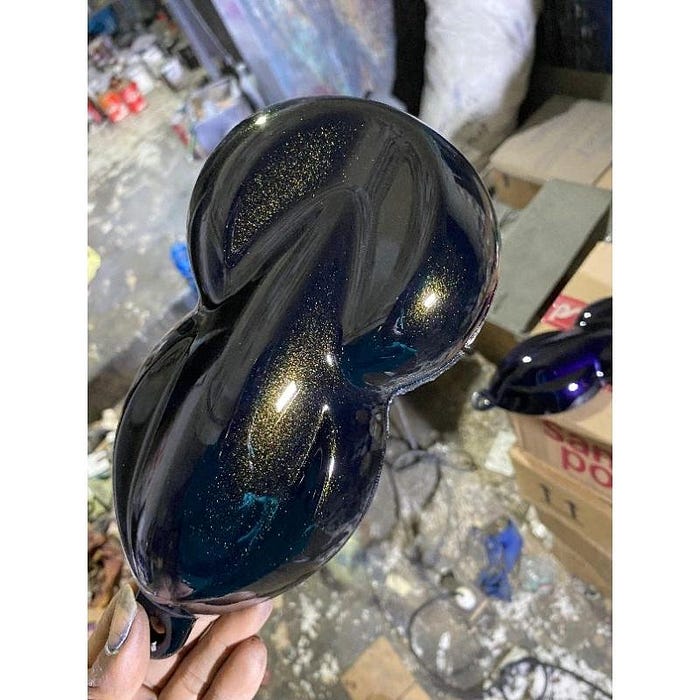
Cat Moonblack gold PU

  Cat Moonblack gold PU  adalah salah satu series yang mengandung partikel kecil seperti crystal yang dan memiliki effect lebih gelap sehing...