Monday, August 22, 2011

I Macchiaioli

The Pitti Palace in Florence is a large collection of museums including an enormous garden housed in the former Medici palace.  I have been to the Pitti Palace several times, but in 2010 for the first time I went to the Galeria dell’Arte Moderna (Gallery of Modern Art).  It was then that I learned about a group of late 19th century Italian painters I had never heard of before, I Macchiaioli.  Specifically this group lived and worked in Tuscany at the same time that the Italian regions and city-states were unifying as the country of Italy.

 
 Giovanni Fattori, Spiaggia Boscosa,1894 (1825-1908)

 
I was truly impressed by their work and wondered why I hadn’t seen them in a book on 19th century artists or read about them in an overview on painting in general. In fact I am having trouble finding a book written in English about this group of painters.  I bought a wonderful book in Italian from the gift shop which has helped inspire me to keep studying Italian but I must admit I read Italian quite slowly.  I want to introduce this group to a larger audience which may not know of their work, but at the same time I am still learning myself of their styles and influence.

 
The name I Macchiaioli is derived from the word for “spots” as in spots of light, shadow and color, think of a “cafĂ© macchiato” which is espresso spotted with milk and it is pronounced much the same way.  The Gallery of Modern Art had the best wall text and gallery overviews, I read them all and took notes too, they gave me a lot to think about- actually they go very in depth. 

 
 Telemaco Signorini, La Piazza di Settignano, 1881(1835-1901)

 
I learned how Italian painters of the 18th and 19th centuries were influenced by French artists with Neoclassical art (a branch of the Bourbon family lived in Lucca), Romanticism (a return to early narrative styles), Realism (peasant scenes ala Jules Bastien-La Page), the Barbizon School and Impressionism.  At the same time they were influenced by the centuries of Renaissance art around them.
 
In thinking of spots of color and in looking at their work it would seem that the Macchiaioli was influenced by the French Impressionists, but in fact they predate them by a decade.  I find it very interesting that both of these styles were developing around the same time in different parts of Europe.  The Macchiaioli painters were subjected to similar ridicule and criticism from art critics as their Impressionist contemporaries.

 
Guiseppe Abbati, Il Lattaio di Piagentina, 1864 (1836-1868)


Here is a quote from the wall text which describes how early 19th century painters were turning away from Neoclassicism:

“Italian artists felt that in order to overcome canons imposed by antiquated models it was necessary, not only to invoke themes of modern history, but to make them more attractive by reclaiming the grand experience of 16th and 17th century art, considered the most appropriate for expression of sublime concepts and natural passions.”

 
After centuries of leading the western world artistically the influence of contemporary Italian artists had waned and was supplanted by the French. However those same French artists were coming to Italy to study the Renaissance. In the late 1800’s Italy was uniting as a country but the Risorgimento had a lot of work to do during the transition. Artists from all over Europe and beyond were continuing to travel to Italy for the “Grand Tour” and their work and presence was in turn influencing the artists who lived here.

 
It seems that I Macchiaioli were using their own experiences and landscape to capture a feeling of rural life and the middle class during the modern age, while at the same time looking toward the great artists of the past who influenced their use of realism and pure color.  Their style was the antithesis of Neoclassical art much in the same way that the Impressionists rejected the painting style of the French Academy.   

 
One main difference seemed to me to be that the Impressionists were mainly concerned about depicting light and color and the Macchiaioli were interested in depicting modern subjects and exploring a new voice for Italian painters.  It is important to keep in mind that during this historic time of Italian unification (and the wars that were fought for the unification to be successful and to be prevented) that it was significant for the artists to find a new style which was both Italian and modern.

 
I am personally impressed by the wide range in styles of the artists, the light that was captured by each painting, the colors that were used, the shapes of the canvases and the feelings that were captured using “spots” of color.

 
 Silvestro Lega, Un Dopo Pranzo, 1868 (1826-1895)

 
Here is the full list of artists in my book on the Macchiaioli called “I Macchiaioli: La Storia, Gli Artisti, Le Opere” written by Silvestra Bietoletti and published in 2001 by Giunti Editore in Florence.  I have hyper-linked those artists that have biographies listed in Wikipedia:

Giuseppe Abbati          Saverio Altamura          Cristiano Banti               Luigi Bechi
Giovanni Boldini           Odoardo Borrani           Ferdinando Buonamici
Vincenzo Cabianca     Niccolò Cannicci           Adriano Cecioni             Vito D'Ancona
Serafino De Tivoli        Giovanni Fattori             Egisto Ferroni                Lorenzo Gelati
Francesco Gioli           Silvestro Lega                Stanislao Pointeau        Antonio Puccinelli
Raffaello Sernesi         Telemaco Signorini       Michele Tedesco           Adolfo Tommasi

I am hoping to learn more about each artist though it will take a while for me to translate my whole book.  But after I do (or find a reasonably priced book in English) I will write more on this wonderful group of painters. In the meantime I hope to see more of their work in person on future visits to Italy.
 

Thursday, August 18, 2011

Sistine Chapel Ceiling Part II: Earlier Influences

My blog post earlier in the week has inspired me to write even more on Michelangelo and the Sistine Chapel ceiling frescoes.  Honestly I could probably write on this topic weekly and still find new things to say, its impact on art was so significant.


At the same time though, while Michelangelo’s frescoes have provided inspiration for hundreds of other artists and artworks, it appears that he also drew on a wide variety of earlier images.  During the Middle Ages and the Renaissance there were certain visual traditions that were used in art to let the viewer instantly recognize the subject.


Michelangelo was from Florence, the city known as the birthplace of the Italian Renaissance where many examples of art could be found.  Michelangelo greatly respected the master painters and sculptors that came before him and drew on their art for his own inspiration.

Temptation, Masolino and Expulsion, Masaccio, Brancacci Chapel, 
S. Maria del Carmine, Florence, 1424-27

One example can be found in Michelangelo's Temptation and Expulsion fresco, he was influenced by the frescoes in Santa Maria del Carmine, the Carmelite church in Florence.  The frescoes in the Brancacci Chapel by Masolino and Masaccio with the same subject matter were works of art that he was known to regularly visit and sketch from.


Let's compare and contrast the subjects.  From Masolino, Michelangelo borrowed the idea of the serpent in the Garden of Eden having the head of a woman rather than that of a snake.  Both artists also focused on the figures rather than the garden setting.  From Masaccio Michelangelo used the idea of an angel with a sword and showing Adam and Eve as having become haggard and miserable as they were forced to leave, both sets of figures appear to be in agony.


Michelangelo's fresco was painted more than 80 years later than the earlier two.  When comparing and contrasting both sets of figures we can see that he spent quite a lot of time studying anatomy.  Drawing from the nude life model was now a more acceptable practice, and while it was still unacceptable to dissect cadavers, his study of bones and muscles has paid off in a depicting very accurate and realistic bodies.

Temptation and Expulsion from Eden, Michelangelo, Sistine Chapel Ceiling, Vatican, 1508-12

Another example can be found in the cloisters at Santa Maria Novella.  The frescoes done outside in the cloister by Paolo Uccello are known as the Chiostro Verde (Green Cloisters) because they have faded after being exposed to the elements and have a greenish appearance.

Interestingly enough they cover the same subject matter as the Sistine Chapel ceiling: The stories from Genesis (Creation of Adam, Creation of Eve, Temptation, Expulsion) and scenes of the Deluge and Noah's Ark.

Santa Maria Novella is the same church that Ghirlandaio and his workshop painted two enormous fresco cycles.  At the time those were being painted, Michelangelo was studying under Ghirlandaio.  He was participating in the fresco painting and would have become very familiar with Uccello's work.

Again Uccello's Temptation scene shows the serpent with the head of a woman, however he takes great care to paint a landscape and foliage in his fresco.  
 Creation of the Animals, Creation of Adam, Creation of Eve, Temptation in the Garden of Eden, Paolo Uccello, Chiostro Verde, St. Maria Novella, Florence, c-1430-1450

Compare and contrast Uccello's Creation of Adam with Michelangelo's Creation of Eve (left hand scene shown below).  Both show God as an old robed man who is helping up the newly created human.  There is something of Uccello's Adam in Michelangelo's Creation of Adam as well, the pose that Adam takes with one straight leg and one bent knee.
I imagine that when they were first done the Uccello frescoes looked much different and would have been quite impressive.  However when compared side by side (done years later) it is easy to see why Michelangelo became such an influence on later artists.  His realism is stunning.

Look at the interesting view of the ceiling below, the combination of large scenes combined with smaller scenes and the painted illusion of sculpture and a cornice is incredible.  Everything you see below is painted and creates both a striking illusion and a powerful narrative.


Last but not least we should remember the influence of the ancient sculpture, the Laocoon, which was unearthed while Michelangelo was painting this in Rome (more information can be found in an earlier blog post I wrote on the Laocoon in July of 2011).  The sculpture can be seen in the left hand column of this blog.

The struggle taking place and the twisting torso influenced those figures known as "ignudi" on the ceiling.  They were the mysterious athletic male figures who frame the corners of each main scene, no two have the same pose.

In a later post I want to highlight some of the later artists that Michelangelo influenced, I already mentioned this in my writing on Caravaggio.  There are many, many other artists that drew on Michelangelo's Sistine Chapel ceiling frescoes as a source.  I think that may be a very long blog post indeed.

Until then here are my book recommendations-
Michelangelo and the Pope's Ceiling by Ross King- I know I just listed it in my last post but this book is really informative and well written.  It is non fiction but feels like a fast paced novel and puts every aspect of this work in a new light.
Michelangelo Biography of a Genius by Bruno Nardini- this is a very good biography.
The Agony and the Ecstasy: A Biographical Novel of Michelangelo by Irving Stone- one of my favorite books, telling the story of Michelangelo through a novel.  This is based on history and research but as a novel isn't 100% accurate, still it is a very good story and will give anyone a new appreciation for this great master.


Monday, August 15, 2011

Michelangelo’s Sistine Chapel Ceiling

We were never supposed to remember Michelangelo when we think of the Sistine Chapel.  In the early Renaissance an artist was little more than a tradesman or artisan.  Art wasn’t created as self-expression but was typically commissioned by a wealthy patron.  Even the best and most highly sought after artists were not considered to be in the same social class as their patrons.  


In the case of the Sistine Chapel the patron was the pope.  Do many people in the 21st century know of Pope Julius II (1443-1513) who commissioned the ceiling frescoes or his uncle Pope Sixtus IV (1414-1484) who remodeled the original chapel?  Both were from the extremely wealthy and influential della Rovere family in Urbino.

 Sistine Chapel Ceiling frescoes, Michelangelo, 1508-12, Vatican


When the Sistine Chapel ceiling frescoes were commissioned the public was meant to remember these two popes from the della Rovere family instead.  It would have seemed unthinkable before their creation that 500 years later instead the ceiling would be forever linked with the artist rather than the patron.


I have been to the Sistine Chapel more than once, and I am also struck by the fact that it is not just the ceiling which is covered in frescoes by Michelangelo.  The entire chapel is covered in frescoes painted by some of the leading artists of the time including Luca Signorelli and then another three who all trained with Leonardo’s teacher Andrea del Verrocchio: Botticelli, Perugino (Raphael’s teacher) and Ghirlandaio (Michelangelo’s first teacher).  It is as if the entire Italian High Renaissance is indebted to the work in the Sistine Chapel.

 Christ Giving the Keys to St. Peter, Pietro Perugino, 1481-82, Vatican


Michelangelo started his artistic training in the fresco workshop of Ghirlandaio in Florence.  He participated in the fresco cycles at Santa Maria Novella in Florence, but he didn’t enjoy the medium.  Shortly thereafter he received training in sculpting and from that point forward considered himself a sculptor.  Later he went to Rome, where he attracted the attention of the Pope with his sculpture of the Pieta.


Pope Julius II saw in the ceiling a blank canvas to express the greatness of the Catholic Church and therefore the implied greatness of the della Rovere family within the church.  However Michelangelo wasn’t interested in the commission at all, he was more interested in the Pope’s original idea of building himself an enormous marble tomb.  When Julius II changed his mind and asked to have the huge and oddly curved Sistine Chapel ceiling frescoed, Michelangelo left and went home to Florence.  The Pope had him followed and asked that he return and the civic leaders made him return so as not to start a war by disobeying the Pope.

 The Deluge, Michelangeo, Sistine Chapel Ceiling, Vatican, 1508-12

Michelangelo returned with a team of assistants, unlike painting on a canvas a fresco was an incredibly difficult process which involved plastering a wall and immediately painting on the wet plaster.  The painting was permanent and had to be removed to fix errors, it took days of four men working together to paint even a small area.


The role of the artist had slowly been changing in the late 15th century and the three great artists of the High Renaissance (Leonardo, Michelangelo and Raphael) played a large role in that.  It is not entirely known what part Michelangelo played in the layout of the ceiling and the depiction of the Biblical stories shown there.  As Ross King writes in his informative book Michelangelo and the Pope's Ceiling (p. 60):


     "For a pope to hand over to a mere artist - even to an artist of Michelangelo's reputation - the
     complete pictorial program for the decoration of the most important chapel in Christendom 
     would have been, to say the least, highly unusual."

Temptation and Expulsion from Eden, Michelangeo, Sistine Chapel Ceiling, Vatican, 1508-12

It is much more likely that there were advisers to the Pope who helped suggest the design and choose the stories to show.  The scenes are all from the Old Testament and relate to rebirth and new beginnings (God creating the World, God creating Adam and Eve, Garden of Eden and Noah's Ark) and therefore indirectly relate to how the della Rovere family helped achieve it's own rebirth of the church.

However Michelangelo visited many churches in Florence and drew on earlier depictions and sources for these (this will be discussed at length in a future blog post).  His new realism and use of the figure to tell stories had an immediate impact when the first half of the ceiling was unveiled to the public in 1510.

 The Creation of Adam, Michelangeo, Sistine Chapel Ceiling, Vatican, 1508-12

The stories were painted in backwards chronological order,  note how much his style was changed and simplified from the first scene showing Noah and the Flood.  In that early painting the scene is crowded with figures.  His work becomes much more effective when he simplifies his style.

He uses the human figure to represent the entire story, leaving out many of the symbols, landscape and backgrounds that other artists were using.  His studies in human anatomy are evident and this key work shaped the direction of the Renaissance.


 God Separating Darkness and Light, Michelangelo, Sistine Chapel Ceiling, Vatican, 1508-12

Pope Julius II recognized the extraordinary skill level of Michelangelo, but it was through his Sistine Chapel Ceiling frescoes that everyone recognized his genius and his status as a "mere artist" was transcended. 
 
Note: For more on this topic my next blog post  Sistine Chapel Ceiling Part II: Earlier Influences, discusses some of the earlier art that inspired Michelangelo.

Suggested Reading:

Tuesday, August 9, 2011

Has Sculpture Become Just Another Pretty Face?


BERLIN — Sometimes on a whim I stop into the Bode Museum here to commune with a tiny clay sculpture of John the Baptist.
It’s in a corner of a nearly always empty room, a bone-white bust, pretty and as androgynous as mid-1970s Berlin-addled David Bowie. The saint’s upturned eyes glow in the hard light through tall windows. Attributed to the 15th-century Luccan artist Matteo Civitali, the sculpture is all exquisite ecstasy and languor.
Sometimes it’s not the saint I check on but a sculptured portrait in the same room of the banker Filippo Strozzi — stern like a Roman emperor, the face of rectitude and power — by Benedetto da Maiano, Civitali’s contemporary. Then I usually climb the stairs to admire Houdon’s bust of Gluck, the composer, and ogle a towering pair of craggy German knights, relics of Renaissance pageantry made of painted wood, each taller than the N.B.A. star Dirk Nowitzki.
Mostly, though, I go to the Bode for the silence.

Like a sentry commanding the northern tip of Berlin’s Museum Island, its back turned to the busier Pergamon Museum, the Neues Museum, the Altes Museum and the Alte Nationalgalerie, the Bode seems to attract just a few handfuls of visitors a day. Some go there to see the paintings, coins and Byzantine art. The sculpture rooms are mostly abandoned.

Is it me, or do we seem to have a problem with sculpture today? I don’t mean contemporary sculpture, whose fashionable stars (see Koons, Murakami et alia) pander to our appetite for spectacle and whatever’s new. I don’t mean ancient or even non-Western sculpture, either. I mean traditional European sculpture — celebrities like Bernini and Rodin aside — and American sculpture, too: the enormous universe of stuff we come across in churches and parks, at memorials and in museums like the Bode. The stuff Barnett Newman, the Abstract Expressionist painter, notoriously derided as objects we bump into when backing up to look at a painting.

A few minutes’ walk from the Bode, the Friedrichswerdersche Kirche, the rebuilt neo-Gothic former church designed by Karl Friedrich Schinkel in the 1830s, houses its own sublime assortment of 19th-century sculpture. It’s usually even emptier than the Bode, and it is free to boot. I’ll occasionally spend an hour or so there, feeling small and unimportant before the portraits of Kant and the great German archaeologist Johann Winckelmann. Except for the doleful guards, I rarely encounter another living soul.

I grew up with the smells of plaster dust and clay in my mother’s sculpture studio on Third Avenue. Making a figure out of stone or metal retains its childlike wonder for me. But sculpture skeptics from Leonardo through Hegel and Diderot have cultivated our prejudice against the medium. “Carib art,” is how Baudelaire described sculpture, meaning that even the suavest, most sophisticated works of unearthly virtuosity by Enlightenment paragons like Canova and Thorvaldsen were tainted by the medium’s primitive, cultish origins.

Racism notwithstanding, Baudelaire had a point. Sculpture does still bear something of the burden of its commemorative and didactic origins. It’s too literal, too direct, too steeped in religious ceremony and too complex for a historically amnesiac culture. We prefer the multicolored distractions of illusionism on flat surfaces, flickering in a movie theater or digitized on our laptops and smartphones, or painted on canvas. The marketplace ratifies our myopia, making headlines for megamillion-dollar sales of old master and Impressionist pictures but rarely for premodern sculptures.

Critics bow to fashion and a legacy of lazy disdain, largely avoiding the topic — I’ve done it myself, so I know — and museums only perpetuate the cycle, offering a steady flow of Botticelli, Monet and Rembrandt exhibitions, before which we genuflect like medieval pilgrims praying before sculptured shrines. But sculpture shows that might broaden our horizons, being costly and difficult to mount, are almost rarer than genuine newly discovered Michelangelos.

In an age of special effects, we may also simply no longer know how to feel awe at the sight of sculptured faces by the German genius Tilman Riemenschneider or before a bronze statue by Donatello. We can’t see past the raw materiality and subject matter. Never mind that Donatello may have been the greatest creative genius until Picasso; he long ago got lapped in the public’s imagination by Madame Tussaud, who has given way to “Avatar” in 3-D and Alexander McQueen’s trippy costumed mannequins.

I read the other day that the Metropolitan Museum had decided to stay open late to accommodate the bewildering crowds for its McQueen extravaganza. Mass hysteria is how a friend described it to me. It clearly became the height of fashion for people to stand in the endless line, if only to have been able to say that they stood in the endless line. How many of those people, I asked myself, stopped to look at any of the Met’s sculptures while they were there, or ever had?
How wonderful, I also thought.

I have the Bode to myself.

Monday, August 8, 2011

Cave of Forgotten Dreams

I just saw the documentary Cave of Forgotten Dreams by Werner Herzog.  Several people recommended the movie to me and I recently went to see it, by now only showing at the discount theater.  Originally it was playing in 3D which would have been interesting but I saw the 2D version.

I know very little about prehistoric or Paleolithic art which was the reason I wanted to see it.  The movie was interesting in the fact that it showed a close up and comprehensive view of caves that are not open to the public.  However it got me thinking about so many different things that I left the movie with more questions than answers, I have been trying to read more and find more information on this period in art since I saw it.  It is fascinating and I recommend watching this.


Wall painting with Horses, Chauvet Cave, France c-30,000 B.C.

Cave of Forgotten Dreams tells the story of the Chauvet Caves in France, apparently this was a relatively recent discovery.  Explorers found this cave in 1994, the cave entrance had been sealed for thousands of years due to a rock slide, which is why the art is still in such a pristine condition.  It is thought to be the oldest cave art in existence, dated around 30,000 B.C.  That over 30,000 years ago there were fairly sophisticated societies making art and music is a difficult concept to wrap my mind around.  There are a number of objects, weapons, altars, paintings, very small sculptures and musical instruments which survive from this Paleolithic era which give historians and archaeologists a good amount of information about daily life.


The documentary explains that this was during the Ice Age and that today's humans (Homo Sapiens) lived at the same time as Neanderthals, a separate species.  There are no art related artifacts found that were created by Neanderthals, the assumption is made that they didn't create any.  Therefore it would seem that the creativity exhibited in early man is one thing that set us apart.  Also early man lived side by side with a variety of animals: enormous cave bears, lions, rhinos and wooly mammoths to name a few.  I hadn't realized lions and rhinos were living in Europe then but there are many images of them.


The movie was interesting but there wasn't much of a reason or hypothesis given as to who created these paintings and why.  In Chauvet Cave it doesn't appear that this was decorative only, but would rather have had a significance, perhaps religious.  There is nothing suggesting people lived in the areas where paintings were, but an object that may have been a type of an altar was found.

I was struck by the paintings of the horses, they appear to suggest perspective which astonished me.  Is this a herd of horses?  Does it represent one horse running or moving?  No one explained it and perhaps no one can.

 Wall painting of Reindeer, Lascaux Cave, France, c-15,000 B.C.


Before this the oldest cave paintings I knew of were in Lascaux, also in France and in Altamira in Spain.  These are both thought to be from approximately 15,000 B.C., which was already hard enough to fathom.  One thing all the paintings have in common is the representation of a variety of animals and sometimes a hunter.

Perhaps the paintings told a story of what happened (such as a hunt) or were a way to pray to god or their gods for a successful hunt.  One of the researchers in the movie suggested that the people who created this believed that a spirit was guiding them to paint.  In one type of cave painting at Chauvet there were many hand prints used as art, created by a man who was 6 feet tall, while that is tall by today's standards that would have been gigantic at the time.  I have been thinking that someone (a priest or priestess figure) would have been designated as the painter, if it was believed that the artist was a medium for a spirit, then probably not everyone would have been allowed to paint.

 Wall painting of Bison, Altamira Cave, Spain, c-15,000 B.C.


How were they created?  Perhaps the paintings were created using hollowed bones to blow pigments on the walls or brushed directly on the surface.  In Cave of Forgotten Dreams, it is mentioned that there were two series of paintings made, approximately 5,000 years apart.  To me this is another staggering figure, but it is also telling that it had long been thought of as a sacred space.


One of the more incredible details was a flute that was found in pieces near the cave.  A scientist put it together and then had a copy made.  It was made using a pentatonic scale (not knowing much of musical scales I had to look that up).  However the holes to make notes were not random and definitely used this musical scale which is widely used today, the same man who had a copy made played The Star Spangled Banner on the flute. 


I think what struck me the most were the ideas in their art that came about much later in art, by artists who couldn't possibly have ever seen the Chauvet cave.  Horses painted in perspective that wasn't rediscovered for millennium and animals carefully painted with shading and texture.  Animals shown as "moving" by having extra sets of legs made me think of Futurism and Cubism.  There was a hybrid creature painted with the head of a bull like the Minotaur from Greek mythology, later used by Picasso as well.  The art had elements of realism, naturalism and abstraction and all of these themes resurfaced in art throughout the ages.


There may not be many physical remains of man from the Paleolithic era but the fact that each civilization builds upon another became eerily apparent when looking at paintings created over 30,0000 years ago.

Additional resources:
Clottes, Jean.  Chauvet Cave (ca. 30,000 B.C.) | ThematicEssay | Heilbrunn Timeline of Art History | The Metropolitan Museum of Art


Tedesco, Laura Anne.  Lascaux (ca. 15,000 B.C.) | Thematic Essay | Heilbrunn Timeline of Art History | The Metropolitan Museum of Art

Thursday, August 4, 2011

How to Ensure the DJ You Hire for Your Event Is the One the Shows Up to Your Event

So you've met with your DJ company for your event, and you are thrilled with the personality and presentation of the owner of the company. He promises to be there and deliver all of your requests as promised. But why do you hear of so many party planners complaining of having a different DJ than promised at their party?

There are many couples and party planners that experience this nightmare all over the country. Right here in Connecticut alone, there a lots of multi operator DJ companies that sub-contract their serves out to other DJ's.

There are thousands of couples tying the knot each year. Thats not to mention Mitzvahs, Company Events, Birthdays, School Functions and more. This a lot of events to be distributed among DJ companies. This leaves room for large firms to double, triple and over-book themselves. When a company grows into a large operation, sometimes quality is sacrificed in the form of outsourcing work. When a company gets offered higher paying, more convenient gigs in the time before your event, it becomes a tempting and irresistible option to send someone else, sometimes a random subcontractor to your event.

The following 3 tips can help you avoid this disaster:

1. Get a signed contract from you DJ service. Many clients tend to overlook the importance of this legal document. Many of my clients trust me so much that I have to remind them to sign the contract long after I have received an on-line payment. Getting the DJ's name on the contract ensures they are legally obligated to send that person.

2. Make sure your DJ company offers a money back guarantee. This along with the DJ's name on the contract will ensure the company will do everything in its power to make sure you are satisfied and delivered what you are promised. With this in mind, despite receiving your money back, once your event is ruined, no money can fix whats already been done. This leads me to the most important tip.

3. Build trust with your DJ company. By meeting them in person and determining their commitment to your satisfaction you can build a relationship based on mutual trust.

Use these 3 tips to help determine if your DJ company has a commitment to your total satisfaction, which will help make your special day stress-free and enjoyable. Over time you will be able to distinguish a professional from an amateur by how the remain committed to helping you along the way.

Wednesday, August 3, 2011

Hugo van der Goes and the Portinari Altarpiece

During the Renaissance there was a significant amount of trade between Italy and Flanders which impacted both areas culturally.  Florence was well known for its wool and Flanders for its cloth and tapestries.  During the 15th century Flanders was comprised of modern day Belgium, the Southern Netherlands and the Burgundian region of France and ruled by the Duke of Burgundy.  

The influence between Italy and Flanders can be seen in many paintings during the 15th and 16th centuries.  There were several wealthy Italian merchants and bankers who commissioned paintings from the highly sought after Flemish artists. 
 Annunciation, Closed Frontispiece to the Portinari Triptych, Hugo van der Goes, c-1473-78


One such example is the famous Portinari Altarpiece, so named because it was commissioned by the Portinari family, which was painted by the Flemish painter Hugo van der Goes.  Tommaso Portinari was a Florentine who worked for the Medici bank in the Flemish city of Bruges.  Over a century earlier the famous author Dante Alighieri wrote The Divine Comedy and in it Beatrice Portinari was his guide through Heaven.  Dante had loved Beatrice from afar since childhood and she became his muse after she had died young.  Tommaso Portinari was a descendant from the same family.


The Portinari Altarpiece was created for the church of San Egidio in the hospital of Santa Maria Nuova in Florence and it is now in the Uffizi Gallery.  This particular work is what is known as a triptych; an altarpiece having three panels, a central panel and two smaller side panels that fold together with hinges.  When closed there is another image known as the frontispiece.  A 15th century Flemish frontispiece was frequently painted using only shades of gray (known as grisaille).  The image on the front corresponds to what is going on inside, here we have an Annunciation where the Angel Gabriel tells the Virgin Mary she is to be the mother of Christ.  This grisaille frontispiece has the look of a marble sculptural relief.
 Portinari Altarpiece Triptych, Hugo van der Goes, c-1473-78, Uffizi Gallery

The Portinari Altarpiece is extremely large, 8’3” x 9’8” (253 x 301 cm).  The theme in the central panel is the Adoration of Christ.  The Holy Family is shown in the manger at Bethlehem surrounded by animals and angels and joined by shepherds.  Each side panel shows members of the Portinari family with their own patron saints.  This is an absolutely beautiful work, startling in its realistic details and jewel-like colors.  We will examine each of the three panels more closely.
 Adoration of Christ, Central Panel of the Portinari Triptych, Hugo van der Goes, c-1473-78


In the central panel there are several objects with symbolic significance in addition to the principle figures at Christ’s birth.  There are lilies in a vase that symbolize Mary’s virginity and purity, and the sheaf of wheat symbolizes the Last Supper.  In a smaller vase there are seven flowers, seven was a common number in Medieval and Renaissance art.  The Virgin had seven sorrows, there were seven sacraments, seven sins and seven virtues.  Three was the number of the holy trinity and four was the number of man (man had four limbs, seasons, elements, stages of life, etc.) and the number seven also symbolized a joining of man and God. One removed their shoes typically as a symbol of respect and the shoe we see would show that this is now holy ground.

The colors in paintings from this era are also symbolic, Mary wears the traditional deep blue which was associated with her.  Joseph wears a red robe, in Christian paintings red symbolizes the Blood and Passion of Christ.  The lilies in the vase are red, white and blue which also tie into the symbolism of Holy Blood, purity and the color of the Virgin.  If you look closely at the background of the central panel you can see that earlier the angels have announced the news to the same shepherds who are now worshiping Christ.  This repeating of figures within a frame is known as continuous narrative and is seen throughout art history from Ancient times through the Renaissance.

Tommaso Portinari and sons with Sts. Thomas and Anthony, Left Panel, 
Hugo van der Goes, c-1473-38

The Portinari’s had seven children and three of them are seen in the side panels along with their parents and their patron saints.  It was very common in Flemish art for the patrons who commissioned the work to include themselves in it.  Just as today when programs or events say “this was brought to you by” and list the individual or organization who paid for it, families or groups who paid for art were included in the artwork.  Though they would be included in a very reverential way, praying to the saints or holy family.  The family is split in two with the men on one side and the women on the other.  Each saint also holds a symbol which would make them easily recognizable to the viewer.  In the background we can see a very pregnant Mary with Joseph on the Flight into Egypt with a donkey, another example of continuous narrative.

Maria di Francesco Baroncelli and daughter with Sts. Mary Magdelene and Margaret, 
Right Panel, Hugo van der Goes, c-1473-78
 

On the right side we see Tommaso’s wife and daughter with St. Margaret (trampling a dragon) and St. Mary Magdalene (with a jar of ointment) and in the background we can see the three Magi on their way.  Notice the hairline of all the women in the painting, it looks like an error but in fact it was the style at the time in Flanders for a woman to pluck back her hairline and have a very high forehead.

Besides the fact that this painting is over life-size, we can tell it was a very valuable painting by the colors that were used.  Pigments that were earth tones were easy to find in rocks, clay and wood.  But the bright reds, blues and greens came from more expensive precious and semi-precious stones which were ground up.  The Portinari Altarpiece has nearly every color imaginable used in it and its size and level of detail took the artist several years to paint.  This work is truly one of the highlights of the Flemish Renaissance.

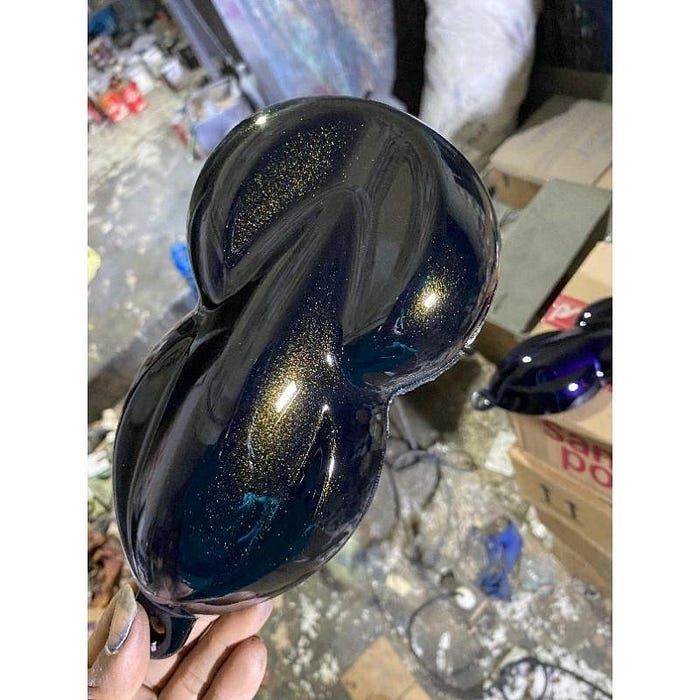
Cat Moonblack gold PU

  Cat Moonblack gold PU  adalah salah satu series yang mengandung partikel kecil seperti crystal yang dan memiliki effect lebih gelap sehing...